 An article in MHI Solutions, written by Tom Gresham, explores how safety continues to guide the Monorail Manufacturers Association (MMA) and its member companies more than 90 years after the organization’s founding. The piece highlights how a long-standing commitment to safe design and operation still shapes the association’s work today.
MMA, an independent affiliated trade association of MHI, traces its history back to 1933. It represents producers of patented-track and enclosed-track underhung workstation cranes and monorail systems. Safety sits at the center of the association’s identity, as reflected in its mission “to promote the safe application and operation of workstation cranes, underhung cranes, and monorails for overhead lifting.”
Making Safety Accessible to Every Manufacturer
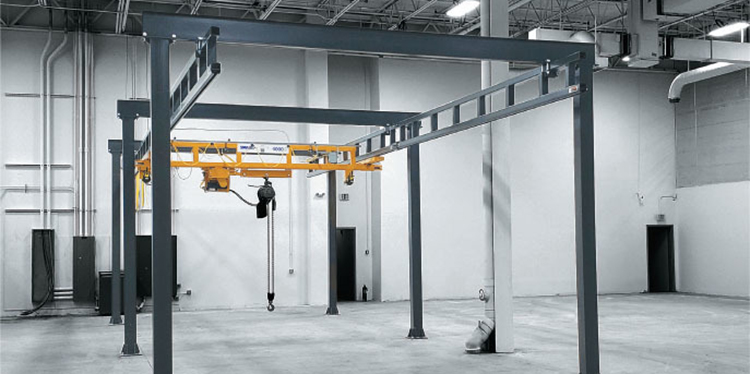
MMA president Jeff Brazwell, president and CEO of MHI member Spanco, Inc., pointed to workstation cranes as a practical entry point. He noted this is particularly true for companies looking to reduce injury risks associated with regularly handling loads heavier than 45 pounds. While traditional overhead traveling cranes can carry a high price tag, Brazwell noted that workstation cranes fill an important gap for smaller operations.
“Workstation cranes are designed for loads of 250 to 4,000 pounds and are priced well compared with other lifting solutions, so they are more accessible to even small, budget-conscious companies,” he said.
Training and Planning Remain Critical
According to Brazwell, most accidents associated with workstation cranes and monorails trace back to human error and insufficient training rather than equipment failure. He emphasized that careful planning tailored to a facility’s specific needs is just as important as the equipment itself. This is especially true of work cells.
“Most work cells have repetitive tasks and the workers should have an enclosed track workstation crane to help them avoid injuries,” he said. He also advised operations prohibit forklifts from entering tight work cell areas.
Emerging Trends Shaping Safer Operations
Brazwell also identified two trends reshaping safety for these technologies. They are: wider use of collision-avoidance systems and growing adoption of motorized systems. He noted that many workstation cranes already move with very low rolling resistance when operated manually. However, motorization is becoming more common because it helps workers position loads with less physical effort.
Equipment features like alarms and proximity systems, which slow equipment as it nears the end of its operating range, are also playing a larger role in day-to-day safety, reinforcing that thoughtful engineering can meaningfully reduce risk on the floor.
Integrating Equipment, Systems, and People
Brazwell was clear that equipment alone doesn’t create a safe operation. Selecting properly engineered lifting solutions suited to the specific task, and understanding how that equipment interacts with other material handling systems nearby, matters just as much.
“Having properly engineered and applied lifting solutions for the specific task from a qualified MMA member company is key,” he said. Brazwell further added that awareness of how a crane interacts with transfer carts, forklifts, or conveyors is essential to avoiding gaps in safety.
A Unified Commitment to Standards
Beyond individual company efforts, Brazwell noted that MMA member companies promote safety through their own websites and customer training. Additionally, MMA and the Overhead Alliance—its collective marketing arm alongside the Hoist Manufacturers Institute (HMI) and the Crane Manufacturers Association of America (CMAA)—maintain an active social media presence focused on safety topics. Underlying all of it, MMA’s design standards help ensure that member products meet baseline safety requirements. MMA members have an active voice in the development and certification of those standards.
As detailed in MHI Solutions, MMA’s decades-long focus on safety continues to evolve alongside new technology, helping manufacturers of all sizes build safer, more reliable material handling operations. To learn more about MMA, visit mhi.org/mma.