Artificial intelligence (AI) is rapidly moving from experimental technology to a practical safety tool in industrial environments. A recent educational webinar—hosted by the Overhead Alliance—demonstrated how AI-powered vision systems reduce risk and prevent accidents involving overhead cranes, forklifts, and other heavy equipment.
The session, Using AI for Safer Workplaces: Practical Solutions for Cranes, Forklifts, and Beyond, featured insights from MHI member AI Key. Presenters Kevin Jeong, CEO, and Luke Lee, Chief Business Officer, explored why traditional safety approaches fall short in high-risk environments. The pair also explained how modern AI systems are helping close long-standing safety gaps.
The Real Cost of Industrial Safety Incidents
Lee opened the presentation by grounding the discussion in industry data. According to statistics from the National Safety Council and the U.S. Bureau of Labor Statistics, a single workplace injury can cost employers more than $40,000 on average. Across the U.S., injury-related costs exceed $760 billion annually.
“In heavy industrial environments, cranes and forklifts account for a significant share of serious incidents,” said Lee. “Crane-related accidents result in an average of more than 40 fatalities per year. Forklifts and other mobile equipment contribute to more than one-third of heavy industry accidents. These incidents impact not only operations and costs, but workers and their families.”
Despite increased training, signage, and safety policies, high-risk incidents continue to occur—even in well-run facilities, he said.
Why Safety Gaps Persist
The presenters identified several reasons traditional safety systems struggle to prevent accidents. These include:
- Human dependency. Most safety programs rely on constant human attention. Fatigue, distractions, and workload make sustained vigilance difficult.
- Policy-driven enforcement. Rules and procedures exist, but compliance is inconsistent and difficult to monitor in real-time.
- Equipment blind spots. Cranes and forklifts create visual and situational blind spots that operators and spotters cannot always see.
- Reactive systems. Traditional cameras record incidents after they occur, offering little opportunity for real-time prevention.
Lee emphasized that many existing systems are passive by design. “In high-risk environments, reacting after an incident occurs can result in serious injuries, downtime, or worse,” he said.
How AI-Powered Vision Makes Cranes Safer
Jeong explained how AI-powered vision systems shift safety from a reactive to a proactive model.
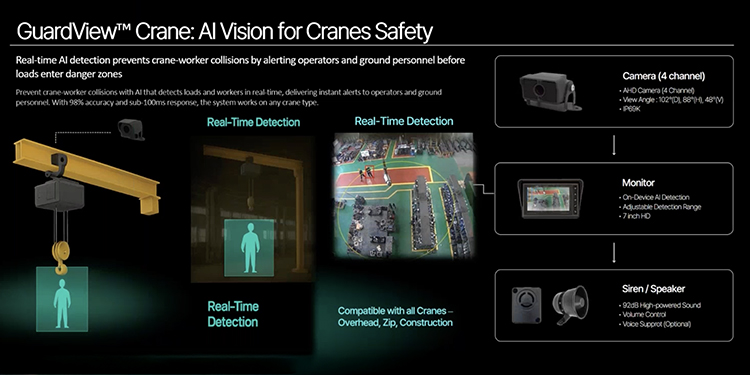
“Instead of simply recording video, AI analyzes live footage in real-time—often within milliseconds,” he noted. “This allows an AI-powered vision system to detect people, equipment, and hazardous situations as they develop.”
Unlike basic motion detection, modern AI systems understand context, continued Jeong.
“AI can tell the difference between normal activity and true safety risks. This reduces false alarms and helps ensure alerts are taken seriously. Because these systems continuously learn from site-specific data, accuracy improves over time,” added Jeong.
In practical terms, AI-powered vision:
- Monitors operations continuously without fatigue.
- Detects unsafe proximity, behaviors, and zone violations.
- Alerts operators and workers before an incident occurs.
- Logs events for analysis and long-term safety improvement.
A key theme of the webinar was the importance of combining edge AI and cloud AI.
“Edge AI runs directly on equipment or cameras, such as on cranes or forklifts,” Jeong noted. “This enables immediate alerts without relying on network connectivity. This is the technology that stops an accident from happening now.”
Conversely, cloud AI aggregates data across an entire site or fleet.
“In the cloud is where AI identifies patterns, near misses, and recurring risks that may not be visible at the individual equipment level,” he added. “The analytics here prevent tomorrow’s accident by allowing operations to address systemic safety issues.”
Applications Across Cranes, Forklifts, and Facilities
Jeong and Lee further explained how AI vision systems can be applied across multiple types of equipment and operations. These include:
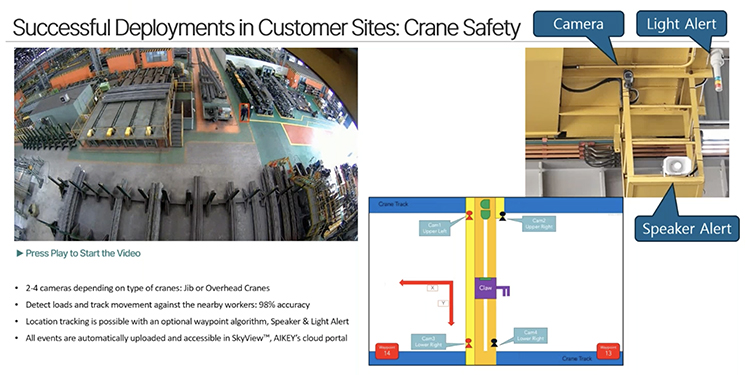
- Overhead cranes: Cameras mounted on cranes monitor the hook, load, and surrounding area. The system alerts operators and nearby workers when it detects unsafe proximity.
- Forklifts and mobile equipment: On-vehicle AI systems detect pedestrians and obstacles in real-time, providing immediate warnings to drivers.
- Facility-wide monitoring: Fixed cameras with edge AI monitor walkways, machine zones, and restricted areas throughout a facility. They can also monitor workers’ personal protective equipment (PPE) compliance.
All detected events are uploaded to a centralized platform. This allows safety teams to review incidents, analyze trends, and prioritize corrective actions.
Improving Accuracy and Reducing False Alarms
One challenge discussed throughout the session was alarm fatigue. Systems that generate frequent false alerts quickly lose credibility with operators. According to Lee, accuracy is one of the main barriers that has slowed AI adoption in industrial safety.
“By training models on real-world industrial environments and focusing on contextual understanding, AI vision systems can reduce false positives while maintaining high detection rates,” he said. “This balance is critical for maintaining trust and encouraging consistent use.”
Beyond cranes and forklifts, the presenters noted several other potential AI-powered vision applications. These include monitoring of other mobile equipment and fixed machines. The system can also connect to wearable devices that directly alert workers to detected risks. As more data is collected, these systems support not only safety improvements but also operational insights.
The webinar concluded with a look at how AI-powered safety systems can be an integrated part of equipment design and facility operations, rather than an add-on after incidents occur.
Learn More About Overhead Crane Safety
The Overhead Alliance—consisting of the MHI Industry Groups the Crane Manufacturers Association of America (CMAA), Hoist Manufacturers Institute (HMI), and Monorail Manufacturers Association (MMA)—promotes the material handling industry by advocating for safe design and usage of products to crane builders and the general industry. The Overhead Alliance provides a unified voice and authoritative resources, offering information on equipment such as hoists, monorails, and cranes.