

Hoist Case Studies Spotlight Custom Overhead Lifting Solutions for Manufacturing
How do manufacturers fit overhead lifting into buildings that lack the space for it? And how do they ease processes that push workers to their physical limits? The Hoist Manufacturers Institute (HMI) shares a series of hoist case studies from its members demonstrating how companies solve these challenges. On its website, HMI presents examples of how hoists enhance safety, ergonomics, and productivity, even in tight or unconventional spaces.
These three HMI hoist case studies show how a boat builder, a sheet metal fabricator, and a pipe producer improved operations with overhead lifting.
HMI Case Study #1: Low-Headroom Hoist and Crane Upgrade Keeps Boat Production Running
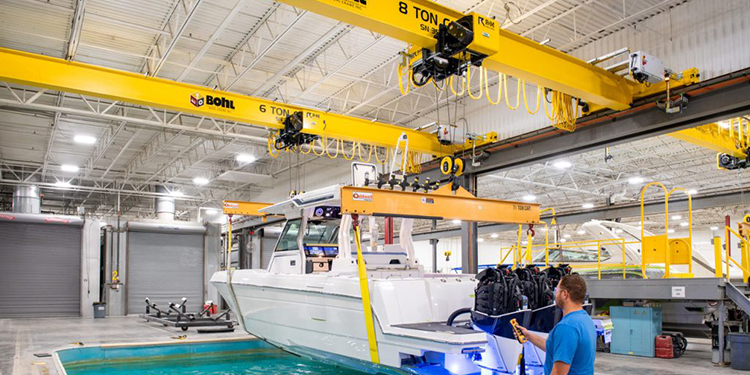
A boat manufacturer needed to replace aging overhead cranes in eight production bays without halting production. Its material handling needs had changed over time, and its existing cranes had mismatched hoists and speeds. The cranes lift boats in and out of indoor pools where the company tests boat motors. That job demands reliable, coordinated lifting. Space posed the biggest challenge. The building had a truss height of 20 feet, 10.5 inches, and a crane rail height of 18 feet, 2 inches. That left little headroom for larger-capacity cranes.
Engineers worked with an HMI member company to design a solution that fit within the existing crane window. Replacing every runway would have cost a great deal and caused significant downtime. Instead, the team reinforced building steel along the runways and columns. It also added intermediate columns midway along each runway. Low-headroom wire rope hoists and crane kits with side-mount end trucks kept each crane compact. Notched girders saved additional space.
Each bay received an 8-ton crane for the heavier stern and a 6-ton crane for the lighter bow. Both cranes span about 47.5 ft. Operators use radio remote controls with an A/B/Both selector switch to move both bridges in tandem. This lets them lift each boat as a single load (pictured above). The team also installed eight 2-ton underhung cranes in a smaller bay.
Crews completed the installation while the plant kept production running on every shift. By avoiding major structural changes, the manufacturer controlled costs and minimized downtime. The new hoists now run smoothly in daily operation.
HMI Case Study #2: Intelligent Assist Device Multiplies Output in Sheet Metal Press Brake Operations
A supplier of components for commercial lawn equipment faced a bottleneck after it installed a new press brake. Workers had to manually lift and form heavy sheet metal into mowing decks measuring 42 to 72 inches wide. Each station needed two workers and produced just three units per hour. The physical strain exhausted operators and drove up labor costs.
The engineering team first explored robotic automation but ruled it out. Robots carried a high capital cost, and they couldn’t provide the tactile control that precise part positioning requires. Instead, the team chose an intelligent assist device from an HMI member company.
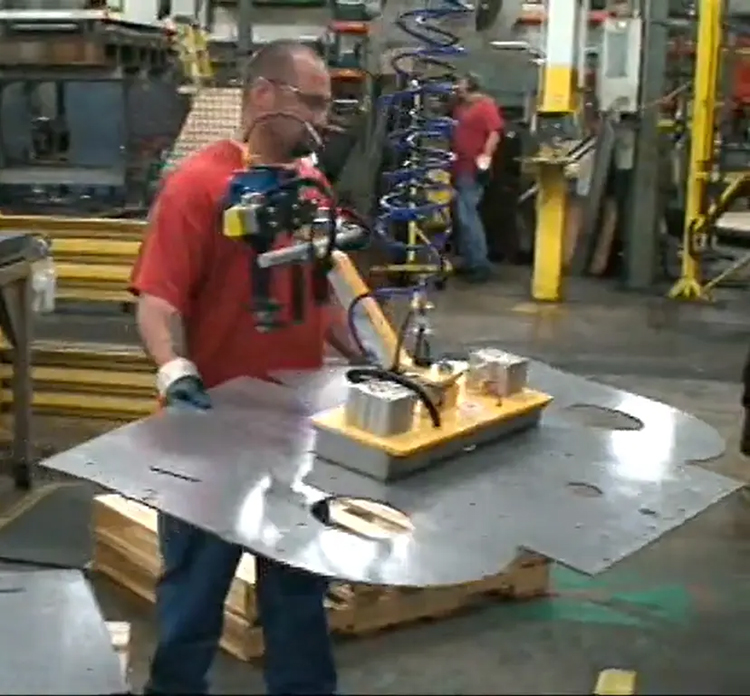
The new lifting device turned a two-person job into a single-operator task. After up each sheet with custom magnetic tooling, the operator engages a float mode. This function makes the load feel weightless. The operator can then guide the heavy deck into the press brake with fingertip precision.
Results came quickly. Production rose from three decks per hour to 15 to 20. Further, the time to complete three bends dropped from six minutes to two. Finally, with one operator per station instead of two, the supplier cut labor costs and virtually eliminated operator fatigue.
HMI Case Study #3: Ceiling-Mounted Workstation Crane Adapts to Sloped Roof in Pipe Manufacturing
A manufacturer of flexible metal hose and piping needed a new lifting solution for its corrugation process. This process transforms smooth metal tubing into flexible industrial pipe 6 to 16 inches in diameter. As pipe lengths grew, so did their weight, making reliable lifting critical to cycle times. Additionally, the facility itself added complexity. Its ceiling-supporting steel pitched in two directions, and the company needed to preserve valuable floor space.
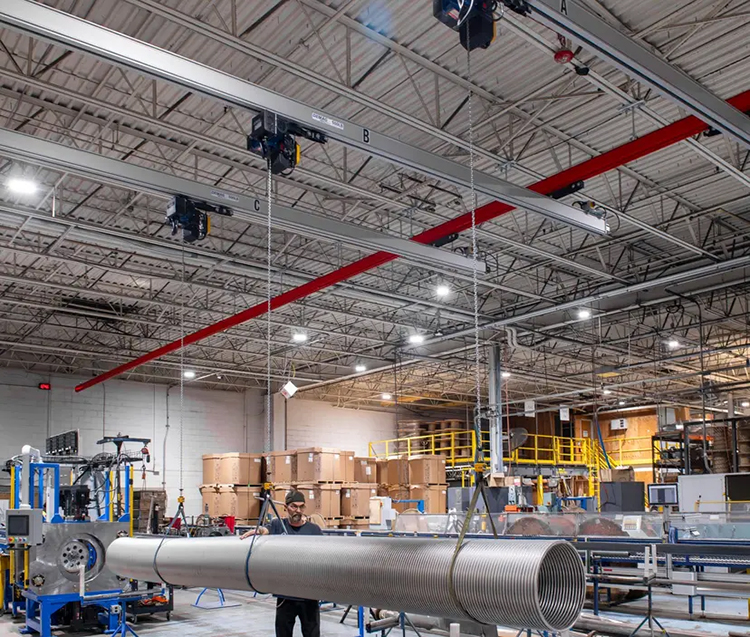
An HMI member company and its distributor evaluated multiple configurations. They recommended a ceiling-mounted overhead workstation crane. Threaded rods of varying lengths attach the system’s articulating suspension hangers to the ceiling. Installers used the rods to fine-tune the crane to match the roof’s slope, both along the runway and across the span.
The installation includes 100 feet of runway, three bridges with 20-foot spans, and a 16-foot lift height. Each bridge carries a two-speed, 500-pound capacity electric chain hoist. The team chose these hoists for their reliability and precise load control in light lifting applications. Workers move the bridges manually with little resistance. That makes the design a cost-effective alternative where applications typically require motorized systems.
The completed system keeps the production floor clear and supports safer handling of heavier, larger-diameter pipe. According to the company’s engineering lead, its corrugation process could not operate without the new crane.
Read More Hoist Case Studies
Hoist Manufacturers Institute (HMI) member companies are the leading suppliers of hoist equipment in North America. Their products include hand chain hoists, lever hoists, trolleys, air chain hoists, air wire rope hoists, electric chain hoists, and electric wire rope hoists. The organization advocates for improved hoist safety and performance. On its website, HMI offers multiple member case studies on the design and use of hoist technologies in different applications. These free publications explore the safety and productivity benefits that hoists deliver.

