MMA Workstation Crane Case Studies: Forestry, Painting, and Furniture Applications
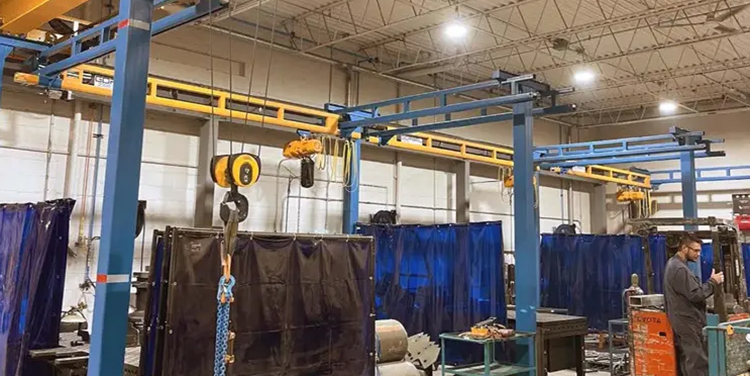
Looking for a real-world perspective on how manufacturing operations use workstation cranes and monorails to solve operational and ergonomic challenges? The Monorail Manufacturers Association (MMA) can help. The organization publishes a library of case studies that detail how innovative equipment and systems enhance productivity, streamline workflows, and improve worker safety across a range of industries.
The following three case studies demonstrate how workstation cranes reduce manual handling, alleviate bottlenecks, and create more efficient, ergonomic processes. Spanning forestry equipment manufacturing, industrial painting, and furniture production, the stories illustrate the measurable impact of well-designed overhead lifting solutions.
MMA Case Study # 1: Workstation Cranes Enhance Operator Safety, Ergonomics at Forestry Equipment Manufacturer
A forestry equipment manufacturer needed a safer and more efficient way to handle heavy components used in the production of felling heads. These parts are large attachments mounted on logging machinery for cutting and processing trees.
In the assembly and welding area, workers relied on a single large crane to move parts into a robotic welding cell. However, this created frequent bottlenecks and downtime. In some cases, employees attempted to lift components manually to keep production moving. This increased the risk of injury and underscored the need for improved overhead lifting safety.
Engineers from an MMA member company provided a solution by installing three workstation crane cells around the existing 5-ton bridge crane. The open-sided design allows materials to flow easily into the welding area without obstruction. Additionally, it permits multiple operators to work simultaneously without interrupting each other. By shifting more lifting tasks to dedicated workstation cranes, the company reduced downtime. It also minimized manual handling, creating a safer, more efficient workflow that supports continuous production.
MMA Case Study # 2: Multi-Step Painting Productivity Improved with Workstation Crane Installation
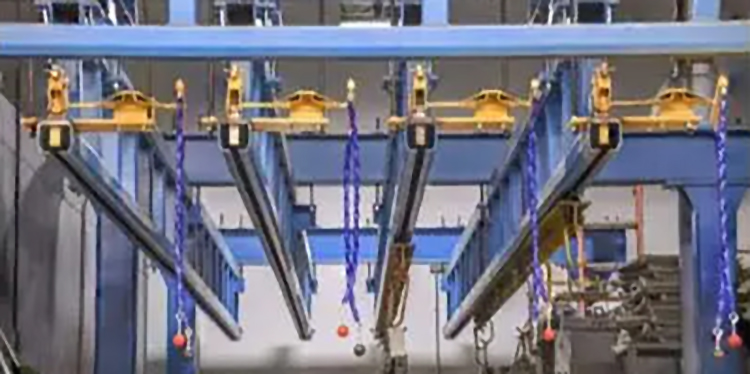
A manufacturer of industrial products sought to improve efficiency while relocating to a larger facility. During the transition, the operation took the opportunity to address persistent congestion and idle materials in its painting bays. Previously, operators used a combination of forklifts and an overhead crane to load carts with paint-ready materials. The painters then manually moved the cart loads in and out of the booth. This required workers to manage the flow of carts and painting. As a result, productivity slowed and workflow bottlenecks developed.
The manufacturer partnered with an MMA member company to identify a more efficient solution. Together, they implemented a freestanding workstation crane system designed with heavy-duty lifting capabilities and a custom interlocking configuration. This setup allowed painters to quickly and easily move a wide range of materials throughout the painting process without carts or additional equipment.
The results were immediate and impactful. By reducing the need for manual cart handling and streamlining material flow, painters were able to work more efficiently and safely. The new system significantly decreased congestion in the painting bays. It also increased throughput and improved ergonomics in a dynamic manufacturing environment.
MMA Case Study # 3: Furniture Manufacturer Eliminates Tandem Lifts with Workstation Crane Solution
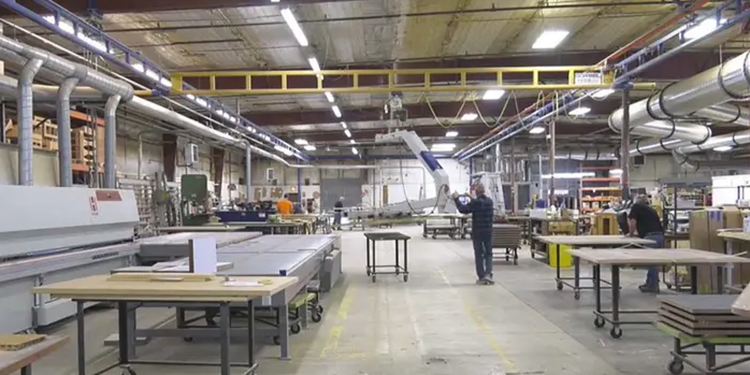
A high-end office furniture manufacturer faced ongoing challenges handling large, heavy components throughout its production process. Workers needed to move pieces that varied widely in size and shape, often requiring multiple employees to lift and position them. This slowed production and increased the risk of strain and injury. As a result, the operation found it difficult to maintain an efficient workflow.
To improve both safety and productivity, the company partnered with an MMA member company. The solution included both a ceiling-mounted workstation crane and a freestanding jib crane. The new equipment allowed a single operator to safely lift, maneuver, and position even the largest furniture components with ease. By reducing the need for team lifting, other employees were able to focus on value-added production tasks elsewhere.
The impact was especially noticeable in edge banding operations, where materials frequently move between multiple machines. Tasks that once took significant time and coordination now take just seconds, dramatically improving workflow efficiency. As a result, the manufacturer achieved a meaningful boost in overall productivity while creating a safer, more ergonomic environment for its workforce.
Read More Workstation Crane and Monorail Case Studies
Founded in 1933, The Monorail Manufacturers Association, Inc. (MMA) is an independent incorporated trade association affiliated with MHI. MMA members produce the the majority of patented and enclosed track underhung workstation cranes and monorail systems. MMA participates in a number of standards developing committees and actively supports the development and certification of safety standards by the ANSI consensus method.
MMA maintains an extensive library of case studies. Member-supplied, these customer success stories detail the ways workstation cranes and monorails support manufacturing, fabrication, and industrial operations across multiple industries. To access more case studies, visit MMA’s website.