Overhead Lifting in Action: Case Studies from Manufacturing, Printing, and Aerospace Applications
Across the material handling industry, real-world case studies provide valuable insight into how companies solve operational and safety challenges. The solutions libraries maintained by the Crane Manufacturers Association of America (CMAA), Monorail Manufacturers Association (MMA), and Hoist Manufacturers Institute (HMI) include dozens of examples. These case studies highlight how overhead lifting technologies improve productivity, safety, and efficiency in demanding environments.
Below are three sample case studies from CMAA, MMA, and HMI. They illustrate how organizations in heavy equipment manufacturing, printing, and aerospace production applied overhead lifting solutions to overcome unique operational challenges.
CMAA Case Study: Fall Arrest System Improves Safety During Mining Machine Assembly
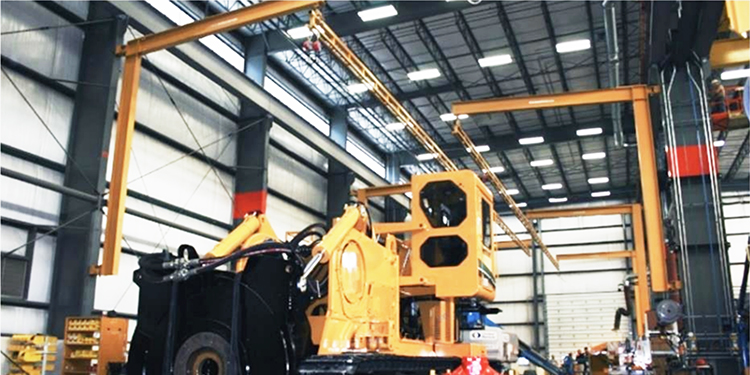
A Midwest manufacturer that builds large track trenching and surface mining machines needed a safer way for employees to work at height during the assembly process. The machines weigh nearly 200 tons and include large grinding surfaces that require workers to access multiple elevated areas. Because of the size of the product, employees regularly worked at heights while assembling components.
The company used several 40-ton overhead bridge cranes to position parts during assembly. However, the cranes’ configuration limited the company’s options for fall-protection systems. Passive restraints — such as removable guardrails — were not practical because they would interfere with crane operations and material movement. Likewise, permanent structures would create obstructions for the cranes delivering parts to workers.
Engineers from a CMAA member company recommended the installation of four, fold-away fall-arrest track systems. These provide overhead tie-off protection without restricting crane movement. The systems feature dual track rails mounted on opposing walls. Their design creates a rectangular coverage area beneath the existing overhead bridge cranes. Each rail supports two workers, allowing up to four employees to safely work on a machine simultaneously. The fold-away design ensures that the system remains accessible when needed while maintaining clearance for cranes and other assembly activities.
The new fall-arrest system allows employees to perform assembly work at height while remaining continuously protected. By providing overhead tie-off coverage across the entire work zone, the system improves worker safety without interfering with crane operations. At the same time, the ability for multiple workers to operate safely on a machine helped streamline the assembly process and improve productivity.
MMA Case Study: Ceiling-Mounted Workstation Bridge Cranes Improve Print Production Efficiency
A digital and offset printing company in Toronto faced growing production demands as it expanded to multiple facilities across the region. To maintain fast turnaround times for customers, production managers needed a safer and more efficient way to handle heavy printing components.
At each printing workstation, workers regularly changed large solid cylinder paint rolls weighing approximately 500 pounds multiple times throughout the day. The process required three workers and a dolly to manually remove and install each roll. Time-consuming and physically demanding, the task created both productivity bottlenecks and potential ergonomic risks.
After evaluating the facility’s operations, engineers from an MMA member company recommended installing several workstation bridge cranes. The ceiling-mounted systems support 1,000-pound loads. Mounting the systems overhead kept floors clear while providing direct lifting access to each printing station.
The enclosed track allows workers to move loads smoothly while maintaining clear traffic paths. With the cranes in place, operators can lift a paint roll directly from the press, remove it, and install a replacement quickly and safely. The new system significantly improved production efficiency. As a single operator using the workstation crane can now complete tasks that previously required three workers. In turn, the new lifting systems helped the facility more than triple its operational efficiency.
HMI Case Study: Custom Hoist and Crane Solution Supports Precision Aerospace Manufacturing

A 420,000-square-foot manufacturing facility producing aerospace components relies heavily on overhead lifting to move delicate spacecraft structures throughout production. The facility spans 25 acres and uses a combination of tooling carts, forklifts, and overhead cranes with wire rope hoists to handle parts and assemblies. When the company added a new building, managers needed a crane system capable of lifting spacecraft structures. Although the parts typically weigh less than 1,000 pounds, maintaining the precision and reliability was critical.
Because of the specialized nature of the work, many loads require custom tooling. During the project, the design team discovered that a fire sprinkler pipe created a low-headroom obstruction the crane needed to clear. HMI member company engineers modified the system’s design to lower the main beam slightly. This allowed the crane to clear the sprinkler piping while maintaining core functionality.
The new system features 5-ton capacity wire rope hoists operating on crane spans ranging from 40 to 65 feet. Variable-frequency drive (VFD) technology provides smooth, precise control, while radio remote operation allows operators to position loads accurately. The success of the initial installation led the facility to subsequently add multiple cranes across several buildings and upgrade older systems to the same hoist platform. With the new crane and hoists, operators benefit from smooth, precise load handling that allows them to move sensitive components safely and efficiently. The cranes operate at controlled speeds and provide the accuracy required for specialized manufacturing tasks.
Read More Overhead Handling Case Studies
The members of the Crane Manufacturers Association of America (CMAA), Hoist Manufacturers Institute (HMI), and Monorail Manufacturers Association (MMA) share multiple case studies on their respective websites. These publications explore a variety of crane, hoist, and monorail solutions and the benefits they’ve delivered to companies across multiple industries.