Overhead Lifting in Action: Manufacturing Case Studies from CMAA
Case studies offer a practical look at how companies apply material handling technologies to address real operational challenges. The Crane Manufacturers Association of America (CMAA), maintains a solutions library that highlights how overhead crane systems support manufacturers. These resources detail how crane deployments optimize production processes, improve workflow, and remain dependable in demanding industrial environments.
The three case studies below showcase overhead crane deployments across a range of manufacturing settings. These include plastics manufacturing, precast concrete production, and shipyard fabrication. Each example demonstrates how thoughtfully engineered overhead lifting systems can enhance productivity, increase operational flexibility, and help facilities manage critical tasks more efficiently.
CMAA Case Study # 1: Freestanding Cranes Improve Mold Change Efficiency
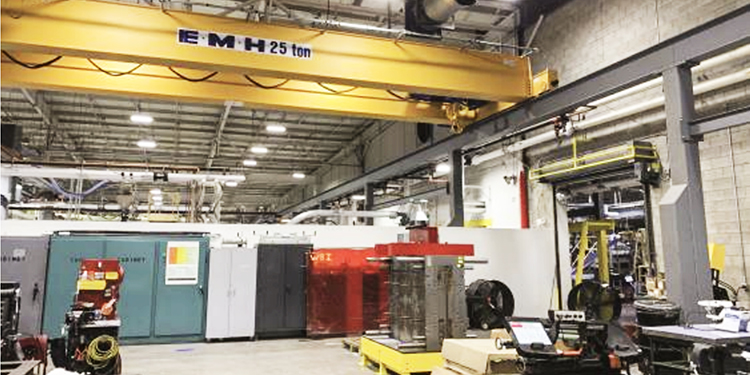
Huhtamaki, a global provider of sustainable food packaging solutions, operates two production facilities in Ohio. At the core of the company’s manufacturing process are large plastic injection molding presses that require periodic mold changes and maintenance. When molds need replacement or repair, minimizing downtime is essential. Previously, the company relied on subcontractors and rigging crews to perform these tasks. However, inconsistent contractor often created delays during time-sensitive production changeovers.
To greater control over the process, the facility installed four, high-capacity freestanding crane systems designed specifically for mold handling operations. Their implementation allows operators to safely lift and position heavy molds across the plant’s main production rooms without relying on outside contractors.
The newest installation included a customized freestanding crane system designed to match the facility’s layout. The system spans approximately 50 feet with a total runway length of about 250 feet, the crane serves multiple injection molding machines. Its step box girder design that allows the hoist to travel between the bridge girders, maximizing lifting height while still clearing roof structures above the machines.
CMAA Case Study # 2: Twin-Girder Cranes Support Precast Concrete Production
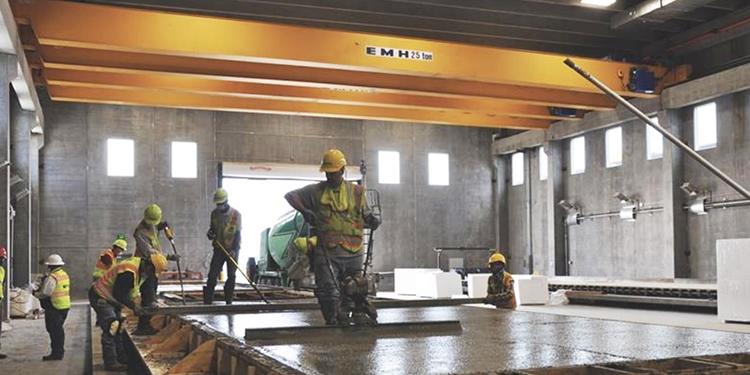
For more than 70 years, Wells Concrete has produced architectural and structural precast concrete products used in commercial construction projects. Because precast components are large and extremely heavy, reliable overhead lifting equipment plays an essential role in daily operations. Therefore, when the company expanded its Colorado facility, it needed crane systems capable of handling large precast components efficiently throughout the production process.
Engineers specified four twin-girder overhead cranes equipped with twin hooks and summation devices. Each crane provides a 25-ton lifting capacity and operates on long runways with spans of approximately 85 feet, enabling operators to move heavy materials across the production floor.
The crane systems were customized to meet the facility’s specific operational requirements. Customization allowed the equipment to align with the plant’s layout and production process, while maintaining the strength and durability required for precast concrete manufacturing. The new cranes also improve workflow. With the ability to lift and reposition products more efficiently, operators can rotate components without handling each piece multiple times. This improvement reduces unnecessary material handling steps, saving time while improving the overall production process.
CMAA Case Study # 3: Dual-Hoist Crane Increases Shipyard’s Fabrication Capacity
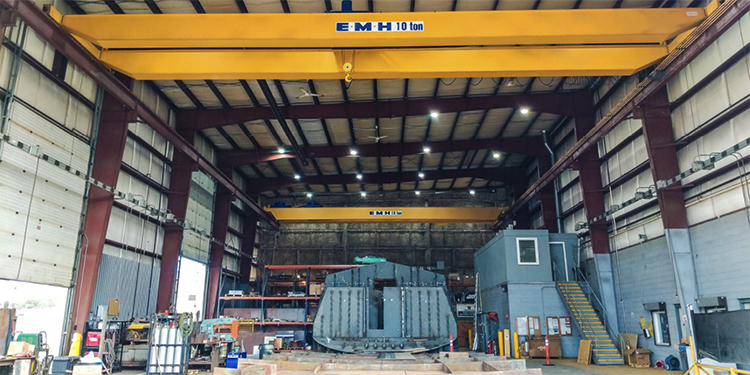
Great Lakes Shipyard fabricates vessel modules and structural components that require precise handling of large steel plates and framing materials. By installing a new overhead bridge crane in its main fabrication building, the company improved lifting capacity while supporting more flexible production operations. The new crane incorporates two independently operated 5-ton hoists, providing a combined lifting capacity of 10 tons. This dual-hoist configuration offers significantly greater flexibility than the shipyard’s existing single-lift 10-ton crane.
During fabrication, large vessel components — such as shell plating and structural framing — must often be positioned and held in place while workers perform welding and assembly tasks. With the new crane system, multiple fabrication teams can work simultaneously while the crane supports components during different production stages. The new crane also improves material handling around the facility’s plasma cutting area. Operators can quickly place large steel plates on the cutting table and remove finished parts once cutting is complete. This allows the shipyard to move materials more efficiently while maintaining safe handling practices.
Read More Overhead Crane Case Studies
The Crane Manufacturers Association of America (CMAA) represents the industry’s leading suppliers of overhead crane systems. They design, manufacture, assemble, install, and service overhead cranes and components. CMAA members — with the combined experience of more than 30,000 crane installations in North America in the last decade — provide products focused on safety and innovation.
In addition to developing and publishing crane engineering specifications, CMAA maintains an extensive library of case studies. Member-supplied, these customer success stories demonstrate how overhead crane systems support manufacturing, fabrication, and industrial operations across many sectors. To explore additional case studies and learn more about overhead crane applications in manufacturing and other industries, visit CMAA’s website.